
« Return to Exploring Children’s Rights and A.I
Over 1,200 children living in Scotland completed a digital survey in June 2023 which explored their views and ideas on A.I, and its use and development in relation to their human rights.
Each survey was completed anonymously by children aged 8-14 years old, supported by school staff but independently filled out by children. The survey and accompanying facilitation instructions for teachers and other supporting adults were designed and produced by Children’s Parliament.
Children could express their views and ideas in more depth through two open-ended questions on the survey if they wished; the answers to those questions formed evidence for reporting and the further project development.
Have a look at some of the key results in the charts and word maps shown on the graphic.
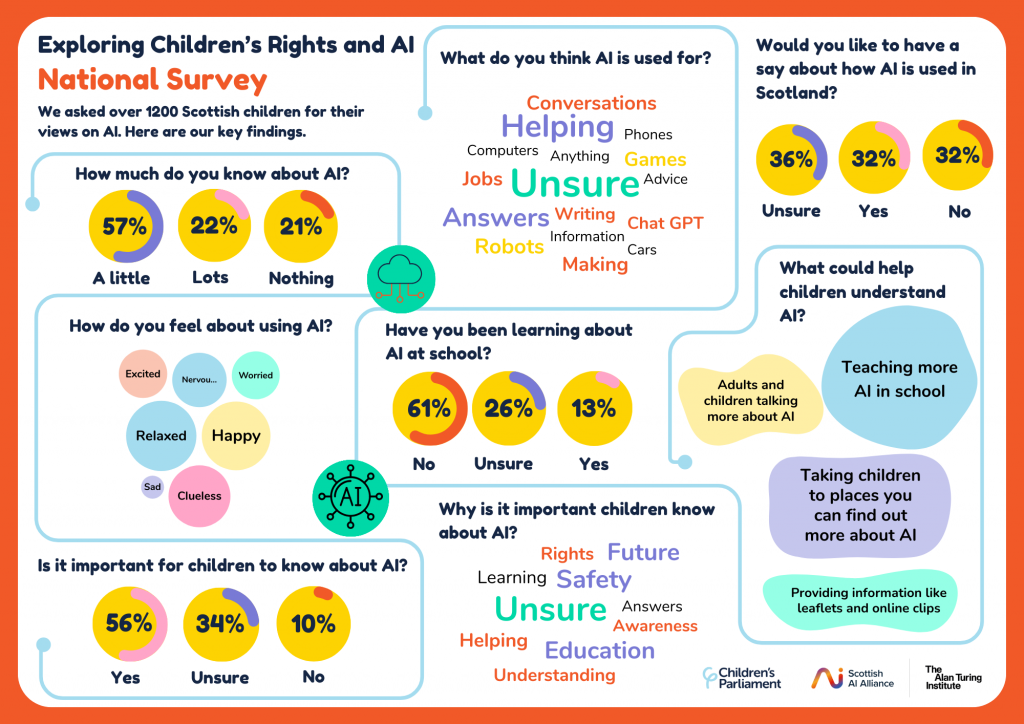
The survey results show a clear need for improved education around A.I for children. 57% of children said they know only a bit about A.I, and 21% said they knew nothing at all. Combined with the fact that 61% of children also told us that they don’t learn about A.I in school, this shows a definite gap in the curriculum on the topic for primary-school aged children and beyond.
56% said that it is important for children, including younger children, to know about A.I, and that the best ways for them to learn about it are through ‘teaching more in school’, ‘taking [them] to places where [they] can find out about it’, and ‘adults talking more with [them] about A.I.’
A general feeling of uncertainty around A.I was also reflected in children’s answers to the question ‘would you like to have a say about how A.I is used in Scotland?’, with 36% responding ‘unsure’ and only 32% responding ‘yes’. Meanwhile, a majority of children reported knowing ‘a lot’ about their rights but only ‘a little’ about A.I. This shows that greater access to education on A.I might support children to be rights-bearers and make informed decisions when invited to contribute their views on A.I use and development. While feelings such as ‘nervous, ‘worried’, and ‘sad’ were commonly expressed in relation to A.I, so too were ‘happy’, ‘excited’, and ‘relaxed’, and children frequently expressed the view that A.I is used for helping people. Children let us know that it is important for them to know and learn about A.I because it helps them feel safe and will help them prepare better for their futures.
Children’s Parliament worked with four schools across the first two stages of the project.
Following this, we sought the views of school staff from across Scotland, with the aim of gaining a clear understanding on how prepared and supported they feel to explore the topic of A.I with children. A national survey was conducted in May and June 2024. The survey collected the views of more than 500 school leaders, teachers, and support staff, all of whom work with children up to the age of 14.
The survey gathered responses on staff confidence in their own knowledge of the subject, what support and resources they had been made aware of, and their own use of A.I. A final open question asked them for their views on the impact of A.I on children’s rights within education, which formed evidence for the project development.
Have a look at some of the key results in the charts below.
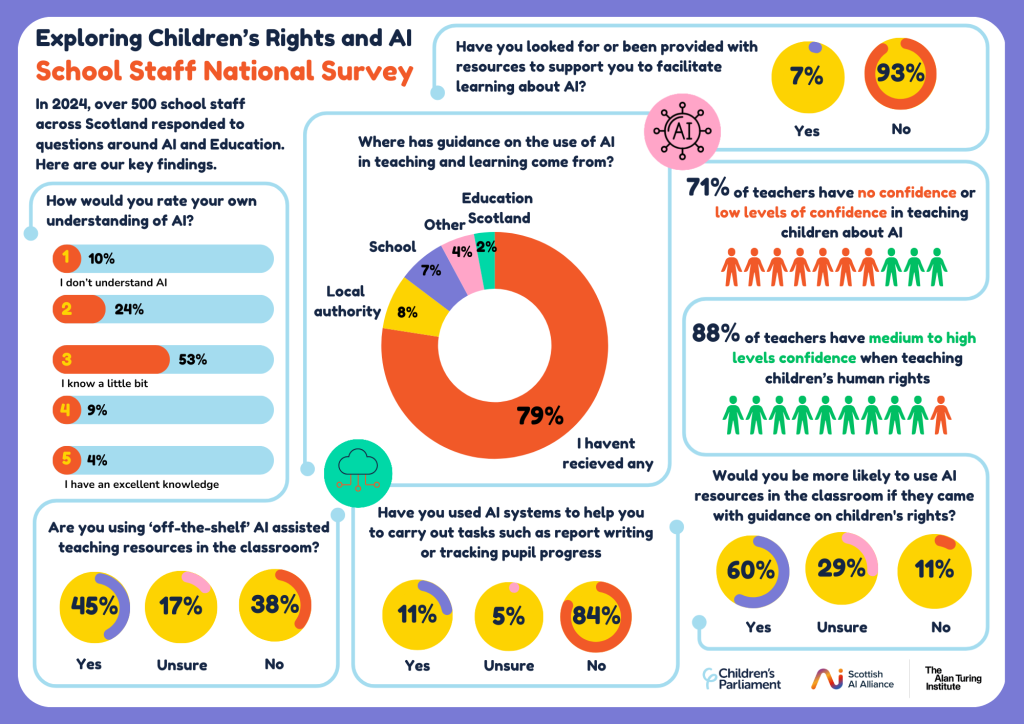
The survey results show that teachers and school staff in Scotland currently lack confidence and support in teaching children about A.I. Of the respondents, 71% had no or low confidence in addressing the subject with their pupils, and 79% had received no guidance on the use of A.I. 93% had not accessed any resources to support teaching children about A.I.
Despite a lack of guidance and support for school staff, at least 45% of those surveyed have used A.I tools in the classroom with children. When considering the children’s call to action – that teachers should learn about A.I and children’s rights to support children’s learning and to keep them safe – the survey findings identify an urgent need for training and resources. A clear positive from the survey is that most school staff feel confident in their understanding of children’s human rights. It is hoped that their understanding will put them in a good position to support children to comprehend the potential impacts of A.I on their lives. Interestingly, only 11% of respondents reported using A.I to help them manage their workload outside of the classroom, for tasks such as report writing or tracking pupil progress. This is despite suggestions that a major benefit of A.I to the Scottish education sector is its potential to reduce bureaucratic workload. Support for linking the teaching of A.I to children’s rights was high, with 60% of respondents saying they would be more likely to use A.I resources if they were accompanied with relevant children’s rights context.
In the survey, we also asked school staff what resources would be most useful to them. Activity packs for use in the classroom and video explainers for children were the two most popular responses. In the 2024-25 academic year, Children’s Parliament worked with children to create these resources.
To discover those resources, visit Exploring Children’s Rights and A.I Resources.